Friday, October 26, 2012

Essay 5c

Time Travel

Question: Find examples and describe the similarities and connections between Scythian, Celtic and Viking iconography. Can you name one other example between three other distinct cultures, time periods and geographic locations? Describe what other discoveries you made in your research.

Part One
Summary: What I gained from the research for this question is a new knowledge that the styles and iconography of Celtic and Viking also existed in the further region of Eurasia, at an earlier time. I had always known of the similarities between the Celts and Vikings, since both cultures are very well known in general. However, I never knew that there were other connections with cultures such as the Scythians. I believed the styles of the Celts and Vikings were common only to the Northwestern regions of Europe. 

Reason: I believe the reason this question was asked was to show how cultures influence each other even when there is a large divide between them.

Purpose: Here the purpose is one with the reason. Each question I have done so far has led to knowledge of connections between different cultures. Understanding these connections helps in understanding the development of art. 

Direction: The direction I took for this question was different than that of the previous questions I answered. Instead of focusing on what books and other sources had to say about the art I was studying, I focused on learning the histories and beliefs of each culture. This in turn helped me to view the art from my own viewpoint without only seeing exactly what sources say is there, thus allowing me to focus on my own opinion. 

Impression: My aha moment in the study of this question came when I found an image of a Scythian bridle ornament that has a goddess and serpents on it. This stuck out the most to me because serpents are used continuously in Celtic and Viking iconography.  


 Part Two

Answer: The iconography of the Scythians, Celts, and Vikings have various similarities. The fact that there are similarities between the Celts and the Vikings comes as no surprise since both cultures were located in the Northwestern regions of Europe. While the two cultures had different beliefs, and therefore different iconography, they were both influenced by the same cultures. The culture of the Celts originated "around 800 B.C. on mainland Europe in an area associated with the Danube Basin" (Who Were the Celts?. Kevin Duffy. Fall River Press: 1999. p. XIII). The Celtic culture spread throughout most of Europe and took its strongest hold in the British Isles, particularly in Ireland where it exists to this day. By the 5th century C.E., "a fusion of Celtic, Roman, Germanic, and Norse cultures" (Art History. Marilyn Stokstad/Michael W. Cothren, Fourth Edition/volume 1, 2011 Pearson Education, Inc., p. 427) existed throughout Europe.

Antlered Figure Gundestrup Cauldron. Silver. 130-1 B.C.
The common styles used within Celtic art are zoomorphic, interlacing, and spiral usage. In ancient Celtic art, the zoomorphic style is most common. This is apparent on a plate of the Gundestrup Cauldron which depicts the horned god Cernunnos surrounded by various animals. The god is depicted with horns and holding a serpent in one hand, both symbols of fertility. Also visible are floral patterns that are surrounded by a rope-like pattern. Perhaps this is the early stages of interlacing which became common later on.

Closeup of page from Lindisfarne Gospels. Ink and tempura on vellum. 715-720 C.E.


The use of interlace and spirals was common in medieval Celtic art and is still used today. Interlace consists "of interweaving ribbons laid out in a balanced and often dazzlingly intricate design" (http://www.ancient-celts.com/AncientVsMedievalArt6.html). Perfect examples of this are in the medieval manuscripts and high crosses of Ireland. In images from the Lindisfarne Gospels and the Book of Kells, "hybrid animal forms tangle in acrobatic interlacing, disciplined by strict symmetry and sharp framing" (Art History.  p. 430). This style present in medieval Celtic iconography is so detailed, intricate, and extravagant, that one could probably spend hours viewing it and still not see every detail. Visible in this image are various ropes that create intricate knots and all seem to be connected, with no beginning or end. Mixed in with the ropes and knots are also serpents that create their own knots that mingle with the interlaced rope. Also visible here are various forms of spirals, some of which are created by the individual circular patterns dominated by a solid purple background, and others that intertwine similar to the ropes and serpents, and fill in any negative space. The filling in of negative space in such a manner is known as horror vacui, fear of negative spaces, and is present not only in Celtic art, but also in Viking and some Scythian art. 


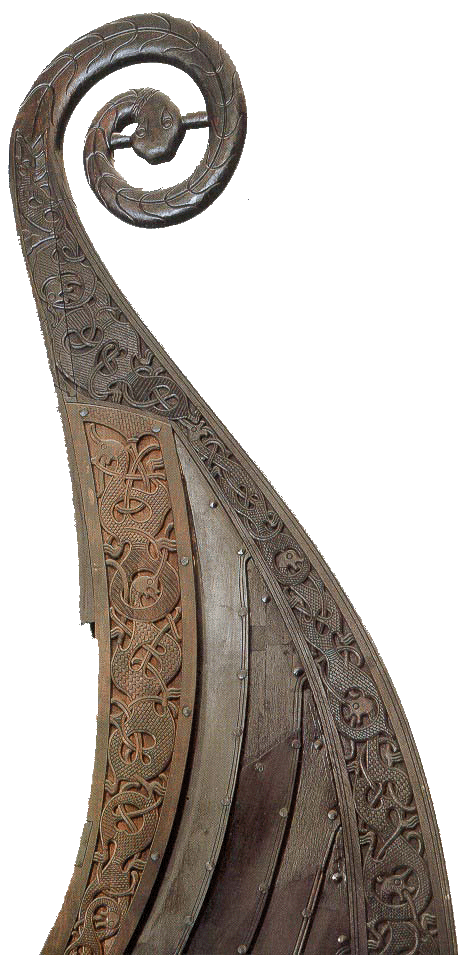
Bow of Oseberg Ship. Wood. c. 815-820 CE
"In the eighth century, seafaring bands of Norse seamen known as Vikings descended on the rest of Europe" (Art History. p. 435). As stated earlier, there was already a Norse influence existing throughout Europe by the 5th century, and so the movements of the Vikings spread this influence further while simultaneously being influenced by the Celts. Both the zoomorphic/animal style and interlace styles used by the Celts are visible on the bow of the Oseberg Ship. Here "the rising prow spirals into a tiny serpent's head, and bands of interlaced animals carved in low relief run along the edges" (Art History. p. 435). The interlacing of these animals are extremely similar to the interlacing used by the Celts. The primary difference is that the Vikings use more animal figures for the interlace than ropes. However, some of these animals appear to be serpents which is a commonality with the Celtic interlacing. Further use of serpents is used in the top of the bow as well as in the stern with the bow spiraling into a serpents head, and the stern similarly spiraling into a serpents tail, thus making the ship one large serpent. Such ships were buried with Vikings because they "symbolised the journeys made by their passengers beyond death in this world to life in another" (The Norse Myths. Kevin Crossley-Holland. Pantheon Books:1980. p. 197).


Scythian Shield Emblem. Gold. c. 7th C. BCE
The Scythians are thought to have originated around the 8th-7th centuries BCE, which is close to the origin of the Celts. However, the Scythians were situated more southeast than the Celts in the Iranian lands. Little is known of Scythians, but what is known comes from the writings of the Greek Herodotus and also from artifacts found at Scythian burial sites. Most of these artifacts are shield emblems in the shape of animals represented in a zoomorphic fashion somewhat similar to the animals of Celtic and Viking art, however they are not involved in any interlacing. What is similar is the use of curvature in the antlers of the stag shown here. All of the s-like curves that make up the antlers seem to be attached giving the antlers a rope-like appearance. The use of these animals as shield emblems is thought to have a religious purpose in that they "were considered to have magical power and to provide protection against evil or disaster" (http://www.hermitagemuseum.org/html_En/03/hm3_2_16.html). This idea is based off the beliefs of other ancient nomadic tribes and is logical to apply to the Scythians because of their use as shield emblems. Perhaps they were used on the shields to ward off evil and disaster in battle.

Bridle Ornament. Gold. c. 4th C. BCE
Because there is little known about the Scythians, this means that our knowledge of their religious beliefs is also limited. However, mythical figures do appear in some of their art, such as what appears to be a goddess on the bridle ornament to the right. The goddess is depicted as being half serpent, which I find interesting. I find this interesting because out of all three cultures, the serpent appears the most. There is a serpent being held by Cernunnos on a plate of the Gundestrup cauldron, serpents appear in Celtic and Viking interlace, serpents (or serpent-like dragons) are used on the prows of Viking ships, and a half serpent goddess appears in Scythian art.

I believe this use of serpents and other zoomorphic figures in all three cultures shows any connections between the cultures. The Celts are thought to have contact with the Greeks, and since an ancient Greek man wrote the histories of the Scythians, we know that the Scythians were in contact with the Greeks. Perhaps the Scythians and the Celts influenced each other indirectly through their connections with the Greeks. The biggest mystery would be who influenced who the most. Did the Scythian use of the animal style influence the Celtic use of the zoomorphic style, or is it the other way around? Either way, a possible connection between these two cultures lays the groundwork for a connection between the Scythians and the Vikings through the Celts. Since the Celts originated in the same location as other cultures that influenced the Vikings, then the influence of the Scythians would have existed already, and thus had an influence on the Vikings. Since there does not appear to be any wide use of serpents in ancient Celtic iconography, I believe that the use of serpents in medieval Celtic iconography by the 5th century may be due to influences from the Scythians.

Or, perhaps there is no connection at all between the Celts and Vikings, and the Scythians. It could just be coincidence that two cultures from one part of Europe and one culture in the Iranian lands are creating art that has similar characteristics. This wouldn't be too surprising to me since pyramids exist in various locations around the world in countries that have no connection with each other such as the Egyptians and the Mayans and Aztecs. Oddly enough, some Mayan religious figures bare an odd resemblance to the gods of the Egyptians even though an ocean separates the two. Maybe the human mind progresses in the same manner and creates the same style of beliefs regardless of location, or maybe there was connections between the two sides of the world that we just don't know about yet.

Friday, October 5, 2012

Essay 4a

Yin and Yang

The Question: What are the similarities and differences between the art of the Western Roman Empire and that of the Byzantine Empire; how did these similarities and differences affect the art of Western Europe and set the stage for the Gothic Period?

Part One
Summary: What I gained from researching this question is a much better understand of Roman art. I had never realized that there were so many fluctuations of style within the empire and had always just though of it as being Roman while looking like it is Greek. In combination with answering this question and the previous question I chose on the first essay, I now have an even better understanding of how events that take place affect the art of a period and how those affects trickle through time and influence the art of later periods.

Reason: I believe the reason this question was asked was to examine how one period of art can be influenced by the art of an earlier period. Also to examine how even though two empires are essentially the same empire, they are both incredibly different, individual empires as well.

Purpose: The purpose of this question was to show how the art of the Eastern Roman Empire and the Byzantine Empire contain similarities, but are also different to a point that makes them two separate forms of art.

Direction: The direction I took with this question is one that will cause me to take a closer look at art and, more importantly, art of preceding periods. By knowing the history and influences of one period of art, I can understand more clearly how and why art develops the way it does.

Impressions: Going back to the summary portion, the discovery of such a variety of art styles within the Roman Empire left the biggest impression on me. I now understand that while the Romans had a love for Greek art, and often copied it, they still strove to create their own styles that would differentiate them from the Greeks.

Part Two
Answer: The Eastern Roman Empire, based out of Rome, grew and eventually dominated most of Europe - primarily along the Mediterranean - and Northern Africa, until the Third and Fourth Centuries CE, when the Empire went through various stages of turmoil. There was a series of "Soldier Emperors", who gained control over the Empire primarily by assassinating the current Emperor and taking their place. This was finally resolved with the rise of the Tetrach system, formed by Diocletian, in which the Empire was split into four sections, each with a different ruler, but all of which ruled the Empire together. With the rise of Constantine as sole Emperor after he defeated Licinius in 337 CE, the Empire's capitol was moved to Byzantium, which Constantine renamed Constantinople. During the period of the Byzantine Empire, many territories that were lost to Rome were regained, and the Empire became mostly Christian - Constantine declared Christianity as the official religion of the Roman Empire - and lasted into the Fifteenth Century.

Within the two Empires, there were various forms of art that continuously changed, usually depending on the tastes of the Emperor. As Rosemarie Trentinella states in an article for The Metropolitan Museum of Art, "Each stage of Roman portraiture can be described as alternately 'veristic' or 'classicizing', as each imperial dynasty sought to emphasize certain aspects of representation..." (http://www.metmuseum.org/toah/hd/ropo2/hd_ropo2.htm). While the art of the Byzantine Empire did not quite fluctuate in such a manner, it did have variations that used both Greek and Roman methods. Even though the two Empires followed similar styles and methods, there were still various differences - alongside similarities - that characterized the art of each Empire.

The Roman Empire begins with the rise of the Republic in 509 BCE. During the Republic, most of the Roman art was based on the art of the Greek world. "The Romans used Greek designs and Greek orders in their architecture, imported Greek art, and employed Greek artists" (Art History, Marilyn Stokstad/Michael W. Cothren, Fourth Edition/volume 1, 2011 Pearson Education, Inc., p. 169). However, unlike the Greek style of general, smooth, eternally young faces, Romans began to focus on the details of a persons face, and in particular, the aged aspects as well as creating the likenesses of individuals. This can be seen on page 171 of Art History in figure 6-13 Portrait Head of an Elder. In this image the signs of aging are apparent in the wrinkles and folds of the cheeks and chin, the sagging under the eyes, the seemingly permanent wrinkles of the forehead, and the loose skin of the neck. This style, known as verism, was important to the Romans of this period who saw the signs of aging as also being symbols of wisdom and experience. Also during the Republic, and further on in Roman art, was the building of temples which generally followed the same pattern as Greek temples. Columns were used around the main temple area, but where the Greeks fully surrounded their temples with columns, the Romans followed a more Etruscan style of having the columns placed in the front, creating one primary entrance. Some of these columns were engaged, or attached to the walls that surrounded the cella.

The Early Empire, beginning in 27 BCE, brought changes that returned the Roman art style back to one more similar to Greek Classicism. This era began with the Augustan age in which artists created "a new Roman form of idealism that, though still grounded in the appearance of the everyday world, is heavily influenced by a revival of Greek Classical ideas" (Art History. p. 174). This style is apparent in the statue known as Augustus of Primaporta, shown on page 175 of Art History. While details are still evident, and the face is easily distinguishable as Emperor Augustus, he is portrayed in the Greek style of youth. Even with age, portraits of Augustus portray him as being young. With the rise of the Flavians in 69 BCE, Roman art returned to the concepts of verism, and signs of age were once again important.

Wall painting also became a popular form of art during the Early Empire. Most wall paintings from this period portray scenes that revolve around Greek mythology and "mystery religions". Scenes were typically backed by solid colors of red or white, which then gave the scene a framed appearance. Giving character and life to these paintings was also the use of linear perspective which was used for painting architecture. A wall painting in the "Ixion Room" of the House of Vettii (Art History, p. 182) displays the beautiful use of perspective with architecture and parts of the walls seem to be windows or doorways into surrounding rooms. In still lifes and portraits, artists employed the use of light and shadow to give objects the appearance of depth, thus rendering the paintings more life-like. Following a similar style of wall painting was the use of mosaics, in which artists use various pieces of pebbles, or small pieces of colored stone or marble. Like wall paintings, artists used light and shadow to create lifelike figures.

Also important to mention is some of the developments in architecture during the Early Empire. Romans began building on a much larger scale than earlier times and built immaculate structures such as the Colloseum, the Basilica Ulpia, and the Pantheon.  The Basilica Ulpia set the general style for basilicas of later periods with the use of a nave and apses. While the main area of the basilica is rectangular and surrounded by columns, following the style of temples, other areas were rounded out into a semi-circular form. Contrasting to the Basilica Ulpia is the Pantheon which is mostly circular - aside from the portico - and was built with a domed roof that contains an open circle in the center called the oculus. This domed roof causes visitors attention to be drawn to the open oculus, and thus to the cosmos.  

The Late Empire of the third and fourth centuries CE brought various changes to Roman art. After a series of "soldier emperors" who failed to keep order in the empire, was the rise of Diocletian in 284 CE. Between 286 and 293 CE he developed a form of government known as a tetrarchy in which four people, two with the title of Augustus and two with the title of Caesar, ruled four quadrants of the empire. "Diocletian's political restructuring is paralleled by the introduction of a radically new, hard style of geometricized abstraction, especially notable in portraits of the tetrarchs themselves" (Art History. p. 205). This form of art can be characterized by a lack of individual likeness. The sculpture The Tetrarchs, shown on page 207 of Art History gives an example of this new art form. Although only two Tetrarchs are visible, the sculpture actually contains all four. The faces of each are similar in appearance, aside from beards on the Augusti. The sculpture contains various geometric shapes and although there is movement portrayed, there is only a minor sense of realism. This plain and geometric form was also portrayed in architecture at this time. A palace commissioned by Constantius Chlorus and his son Constantine was built in a highly simplistic manner. The building is rectangular with a semi-circular apse on one end and has multiple windows, but has little to no decorative aspects.

At the beginning of the Fourth Century, the Tetrach system began to fall apart when its creator, Diocletian, abdicated and forced the other Augustus, Maximian to do the same. After this, small battles broke out between the younger Caesar's as they fought to gain control. Constantine was victorious over Maxentius and ruled for a short period with Licinius. Eventually he also defeated Licinius, who had become his rival, and assumed sole rule of the empire. At this time, he declared the new capitol of the Roman Empire to be the port city of Byzantium, which he then renamed Constantinople in honor of himself. Thus begins the rule of the Byzantine Empire.

The art of the Byzantine Empire can be characterized by the development of the Christian religion. Various churches were built throughout the empire which contained religiously themed frescos and mosaics. Most popular was the building of domed churches which seem to have built with the Basilica Ulpia and the Pantheon as inspiration. The Church of Hagia Sophia portrays this incredibly well. Built up on a mostly square foundation is one large dome flanked by two half domes and various apses. Unlike the Pantheon, the base of the large dome contains forty windows, allowing an incredible amount of light to enter into the naos (the nave and sanctuary). Also following the style of the domed church is the Church of San Vitale in Ravenna. "The design of San Vitale is basically a central-domed octagon surrounded by eight radiating exedrae (wall niches), surrounded in turn by an ambulatory and gallery, all covered by vaults" (Art History. p. 237).

Decorating the walls of such churches are an incredible variety of mosaics and frescos. These mosaics and frescos are of religious scenes, such as stories from the Bible. Some mosaics, such as the Empress Theodora and Her Attendants located in the Church of San Vitale, employ the use of Classical styles similar to those used in Roman frescos; an open doorway and use of shadow. However, these are not used to the same extent as the Romans did so that the focal point of the people is not overcast by the illusion of three-dimensional space. Such scenes "are both flattened and three-dimensional, abstract and representational, patterned and individualized" (Art History. p. 241). The individualization of characters is not like that of individual characters of most Roman art. Instead of characters having a likeness to the real person, they are often individualized by their clothes, location within the scene, or by their names which were located underneath or close by them.  

Such scenes were not only on the walls of churches, but also appeared within manuscripts. Religious scenes typically accompanied writing on an individual page, but occasionally took up entire pages, such as in the Paris Psalter. One example within the Psalter is a piece called David the Psalmist (Art History. p 253). The scene fills up the majority of one page, is framed with a geometric pattern, and employs many Roman art styles. At the top of the scene, situated in the background, is a building that was painted with the concept of perspective in mind, and seems to retreat back into the scene. The setting of the scene within an outdoor landscape is also reminiscent of Greek and Roman art, but was not commonly used in this period.

Also created during the Byzantine Empire were icons, which at the time were typically portraits of Christ, Mary, or the Saints that were painted on wooden panels. These were used as a sort of contemplational focus while people were praying. Unfortunately, the use of these icons sparked a large scale debate that focused on the proper use of icons in worship. Many saw it as another form idol worship which is forbidden in the Christain religion. During this debate, "Emperor Leo III launched a campaign of iconoclasm ('image breaking'), banning the use of icons in Christain worship and ordering the destruction of devotional pictures" (Art History. p. 245). Fortunately, this did not last and after 843 CE, the use of icons returned. This would not be the last time such a debate would rise up. Throughout history, it happened in various places and much art would be destroyed. For instance, another wave of iconoclasm swept through parts of Europe during the Protestant Reformation and many wonderful works of art were destroyed.

Although there are many ways in which the art of the Eastern Roman Empire and the Byzantine Empire are similar - use of Classical scenes, domed churches that also followed the style of basilicas, and use of shadow and perspective - they are also quite different and easily distinguishable. The first and foremost difference is the scenes depicted in the art. While Roman art displays mystical scenes taken primarily from Greek mythology, Byzantine scenes are focused around the Christain religion with an occasional inclusion of mythology. While Roman portraiture did cycle through phases of verism and classicism, the artist almost always portrayed faces as being an incredibly well likeness to who they were sculpting or painting. On the other hand, the faces of people in Byzantine art all follow a similar pattern and are not distinguishable from one another unless other details are focused on.

However, the art and architecture of both empires played a role in setting the stage for the Gothic period. Prior to the Gothic period was the Romanesque period, which is so called because of a revival of Roman architecture such as the domed roof. Leading into the Gothic period, architects wanted to create even taller churches and cathedrals and so employed the use of the pointed arch, which of course is not similar to Roman or Byzantine art. What is similar though is the effect the architecture of such buildings had on the human eye. Like the Pantheon, the large ceilings pull a viewers focus upwards towards the heavens. Where the Byzantines used frescos or mosaics on the domed ceilings, artists of the Gothic period used stained glass. What is interesting here is that use of a rose-window was common in Gothic times. The rose-window is typically a circular flower shape, and similar to the scenes of the Byzantine domes, the stained glass in the window would have either God, Christ, or Mary in the center surrounded by Biblical scenes. Also, the stained glass windows that would surround Gothic cathedrals would portray Biblical scenes in the same manner as the mosaics and frescos that covered the walls and roofs of Byzantine churches.


Tuesday, September 25, 2012

Essay 5a


Essay 5a

Man and God

Question: Could the art of the Gothic period, in your estimation, be similar to, or parallel with, in any way, the Amarna period (1353 BC-1335 BC) in Egypt and if so; what were the historical aftereffects of each period or, if you think not, why?

Part One
Summary: What I experienced in the study of this question was not what I expected. I found that not only was there similarities within the artwork from the Amarna Period and the Gothic Period, but there were also similarities in how the artwork evolved from each respective preceding period. The art from the Amarna Period changed from the art of earlier Egyptian periods in the same way the art of the Gothic period change from the earlier Medieval periods.

Reason: I believe this question asked to discover not only the connections of artwork from two separate periods, but also to discover how the art from each period similarly changed from their respective previous periods.

Purpose: The purpose of this question was to cause me to look past the artwork itself and pay attention to the developments and changes that led up to each style of art.

Direction: The research of this question only reinforced beliefs I already had about how each civilization influences the next, and how while things change through time, they also stay the same. I enjoy finding ways that history repeats itself in order to know how it does, and so the research of this question led to another discovery of how history can be repeated.

Impressions: I had one of those "aha moments" while researching this question. As I was reading about the differences between Gothic art and Romanesque art, it hit me that the differences between the two were the same form of differences between Amarna Period art and its preceding Egyptian periods. Then I realized that was the primary connection between the Amarna Period and the Gothic Period.

Part Two
Answer:  Connections in the artwork from the Amarna Period and the Gothic Period exist not only within the artwork, but in how the art from each period became what it was. To see this, one must first compare the differences between Amarna art and the art of earlier Egyptian periods, and then the differences between the Gothic Period and earlier Medieval periods. Then it is easier to see the similarities between Amarna and Gothic art for what they truly are, developments in artistic style.

Artwork of Egyptians periods preceding the Amarna Period:


F. 1 Ti Watching an Elepant Hunt
Painted limestone relief.
c. 2400BCE
In the time before the rein of Akhenaten and Nefirtiti artwork, such as sculptures and relief carvings, followed a traditional and mathematical style. Portrayals of people and the surrounding environment were "often based on conceptual principles rather than on the observation of the of the natural world with an eye to rendering it in lifelike fashion" (Art History. Fourth Edition. Vol. 1.Marilyn Stokestad. p. 51). In relief carvings, parts of the body such as the head, hips, legs, and feet were portrayed from a profile, while the eyes and torso were portrayed from a frontal view. This helped to show every aspect of how a persons body was to be reconstructed in the afterlife. The main figures of this artwork were typically standing straight up, perhaps in the midst of a stride to show both legs and feet, and had a sense of rigidity. Kings were typically portrayed as being incredibly larger than others within the relief who were of lesser status. While the king was shone standing, or in the midst of walking, lesser people, such as scribes, hunters, etc., were shown as being involved in tasks and thus appeared more life-like than the king.


F. 2 Menkaure and a Queen
Graywacke with traces of red and black paint.
 c. 2490-2472 BCE.
Statues from earlier Egyptian periods follow a similar, rigid format. Being that statues are three dimensional, there was not a need for portraying a person in the point of view used in relief carvings. However, people, primarily kings, were still portrayed as standing or sitting perfectly upright. They appear extremely stiff, as if there is actually no natural curvature to their spine. The statue of Menkaure and a Queen (fig. 2) shows Menkaure with his shoulders slightly back, chest up, and arms perfectly straightened at his side. Even the queen is standing perfectly upright. Both figures project a feeling of importance and refinement. Even today we would expect a person of the wealthy upper class, or of nobility, to present themselves in such a posture. Also interesting to this sculpture is how the faces of the man and women are almost identical. While the mans is longer and thinner, and the woman's shorter and wider, the appearance of the eyes, nose, mouth, and cheek bones follow the same uniform style. There is no particular focus to the individual appearance of each person.

Artwork of the Amarna Period:

After Akhenaten took the Egyptian throne in 1353 BCE, the style of artwork began to change. Not long after beginning his reign, Akhenaten changed the Egyptian religion from a polytheistic one to that of a monotheistic one which worshipped the sun god Aten as the sole god. Aten is represented in art from this period as a sun disk with multiple rays that end in hands. With this new religion, artwork seems to have changed its focus. Work became less mathematically proportionate and began to focus on the features of the individual. This is apparent when viewing the statues of Akhenaten and his queen, Nefertiti; both are shown below.

F. 3 Nefertiti  Painted limestone. c. 1353-1336 BCE
Colossal figure of Akhenaten Sandstone with traces of polychrome.
 c. 1353-1349
When comparing these two images to the statue of Menkaure and a queen, striking differences are visible. First off, Akhenaten and Nefertiti look incredibly realistic and it is obvious that they are two different people. In earlier Egyptian art, people were differentiated by such items as clothing and objects they were holding. But these two statues are not only differentiated by the objects, but by their facial features, which do not follow a uniform formula such as the statue of figure 2. Akhenaten has a long face, large ears, and a mouth that has a touch of a smile. If the entire statue was in the picture, it would be visible that his body is not perfectly proportionate, nor is it athletic looking. His torso is long and lanky, while his hips and upper legs are much wider and his stomach sags slightly. This contrasts largely to the image of Menkaure who is portrayed as being in perfect shape, with an unrealistically proportionate body. Nefertiti has almost no similarities to Akhenaten in the way that the queen with Menkaure does. The portrayal of her facial features make it clear that she is woman. The features are smaller and much more feminine. Instead of a rounded out face such as the queen in figure 2, her jaw line is accentuated, as well as her cheek bones. The appearance of both figures portray incredibly real people. (There are some pictures of this Nefertiti bust taken from slightly below and the effect that has makes her look as if she is literally alive. Perhaps this bust of her was meant to be viewed from below. http://the100.ru/images/womens/id850/3339-nefertiti11.jpg)

F. 4 Akhenaten and his Family
Painted limestone relief. c. 1353-1336 BCE
Portrayals of the royal figures in relief carvings also changed drastically. Originally, royal families were portrayed with the King much larger and standing in his own space, while the other members of his family were smaller and stood around him. The Amarna artwork brought the view of the royal family to an entirely new perspective. The relief carving of Akhenaten and his family (fig. 4) portrays both himself and Nefertiti seated. Akhenaten is shown as being only slightly larger than Nefertiti, which is more realistic to how a man could be larger than a woman. The interesting aspect of this relief is the interaction taking place between the king and queen, and their children. "Rather than composed serenity, this artist has conveyed the fidgety behavior of children and the loving involvement of their parents in a manner not even hinted at in earlier royal portraiture" (Art History, p. 71). In this relief, it is easy to imagine the royal family spending time together and interacting in a way similar to parent/child interaction visible today.

All in all, the art of the Amarna period became more relaxed in comparison to earlier Egyptian art. The figures lost their rigid poses. Their backs (refer to figure 4) have a natural curve and their shoulders are slightly slumped showing that the figures are not sitting perfectly upright. Even though the traditional styles, profiled heads, legs, feet, with frontal eyes and torso, are still portrayed, it appears more natural. The frontal torsos have a feeling of being frontal because of the way the figures are positioned, not because of an aim for completeness. The manner in which all people are positioned are in such a way that you would expect to see both shoulders. Also important to the changes of art in the Amarna period is the focus on the individual and a change to realism. People are more easily differentiated based on their physical appearance than by the hieroglyphics that accompany them.

Artwork of early Medieval periods:

Art throughout the various Medieval periods underwent many changes, all of which eventually led a "new" style of art in the Gothic period and on into the Renaissance. Many of these changes took place within architecture where buildings went from having curved arches and curved roof domes such as in the Romanesque period, to having pointed arches and domes such as in the Gothic period. What is interesting here is how there is a return to a triangular point similar to that of the Egyptian pyramids, as well as other pyramid styles scattered across the globe.


F. 5 Virgin with Child
 Oak with polychrome.
Late 12th Century.
 
The minor arts of these periods are items such as sculptures and illuminated manuscripts. Similar to early Egyptian art, sculptures portrayed an unrealistic rigidity to the persons being sculpted. One of the best examples of this are the statues of Mary and the child Jesus. Generally known as the Throne of Wisdom, Mary is sculpted sitting in an upright position that has a feeling of formality. The baby Jesus is shown sitting on Mary's lap in a similar, stiff position. This type of statue, shown in figure 5 shows Mary and Jesus as having similar and plain faces. There is no expression to the faces and if not for the size differences, the age difference would not be over distinguishable by studying the faces. Although Mary has her hands held in front of Jesus, it is not in an affectionate embrace, but one that portrays protection; Mary is the mother and therefore must protect her child.

Another example of the lack of realism within sculpture from early Medieval periods is a sculpture of Christ and two disciples from the Romanesque period; shown on page 452 of the Art History book. All the faces of the three people have similar characteristics with the differences being in the facial hair. The fingers of the people have an unrealistic portrayal as being close together and overly rounded out, as if there are in fact no bones in the fingers. Although there is detail to the robes worn by the three, there is a feeling of the robes being extremely flat with no sense of flow.


F. 6 Chi Rho Iota page Book of Kells
Oxgall inks and pigments on vellum.
 Late 8th or early 9th Century.
Illuminated manuscripts are a highly popular item from all Medieval periods. In early Medieval times, illuminations often portrayed a feeling of being incredibly colorful, but in reality there were only colors of blue, red, gold, green, and white. This is visible in the Chi Rho Iota page from the Book of Kells (fig. 6). Also noticeable is the extravagant patterns that cover the page. Every bit of the artwork feels as if it is all intertwined with no beginning and no end. This type of artistic style was common in illuminated manuscripts along with the portrayal of the natural world with various animals, which were not typically lifelike. As illumination developed and became more popular, people were often portrayed as well as the usual patterns and animals. However, these people appeared just as Christ and his disciples previously mentioned. The faces all have the same look, the hands seem to have no bones, and the clothing as well as all other aspects have a minuscule amount of depth and realism. For an example, refer to page 486 of Art History and glance at the image of St. Matthew, from the Codex Colbertinus. The writers of the book even describe this piece as having "little sense of three-dimensionality, with solid blocks of color filling its strong outlines".

Artwork of the Gothic Period:

F. 7 Ekkehard and Uta  (hand close up)
 Stone with polychrome. c. 1245-1260
While many changes that took place in Gothic art began to appear in Romanesque art, the changes almost fully took place with the Gothic period. In place of sculpture, stained glass took over within cathedrals. While statues still appeared inside and outside of the cathedrals, they were not the main artistic focus. The images that appeared in stained glass still did not contain a large amount of depth, but they portrayed more stories and details than what was previously portrayed by statues and sculptures of cathedrals. What is most interesting about the stained glass windows is the striking similarity to the relief carvings of Ancient Egypt.
The pictures are assembled in a manner that portrays a story from beginning to end. In regards to sculptures, those became much more realistic within the Gothic period. Where the sculpture of Christ and his disciples was lacking in realism, the statues of Ekkehard and Uta (fig. 7) are incredibly realistic. Their robes are not flat as are those of Christ and his disciples. Instead, they portray volume and a natural flow as they fall around the bodies of Ekkehard and Uta. The most striking contrast of these statues from those of the preceding Medieval periods is the amount of detail and realism that is portrayed in Uta's hand. The fingers are not pressed together as in earlier sculptures but are spread out giving each individual finger a life of its own. Also visible is the appearance of bones in the fingers, which are no longer rounded out as in earlier times.

F. 8 Virgin and Child with the Artist Kneeling
Ink and color on parchment. c. 1250-1259.
 
Another major change that took place during the Gothic period that should be brought to attention is the appearance of Mary and the baby Jesus. As previously mentioned, the two were typically shown sitting rigidly on a throne. There is a lack of affection, but a portrayal of protection. In the Gothic period, this changes to show Mary and baby Jesus as being affectionate to one another as one would expect a mother and child to be. Figure 8 gives an example of this showing Mary holding baby Jesus close to herself, with her cheek resting gently against his, while he gives her a loving embrace. Statues of Mary and baby Jesus also portray another form of realism by showing Mary standing while holding baby Jesus and balancing her weight to one side to support the weight of the baby.

Similarities of Amarna and Gothic Art:

As apparent from the writings above, the primary similarity of artwork from both the Amarna period and Gothic period is how they changed from artwork that was previously rigid and formal. In the same manner, each periods portrayal of people developed from everyone having a similar style face to faces being represented as that of an individual. What is perhaps the most interesting is the changes in the portrayal of royal Egyptian families and the portrayal of Mary and baby Jesus. In both cases, the royal families, and Mary and Jesus were shown in extremely formal, stiff poses that completely lacked any form of affection. Then in both periods that changed to artists depicting the Amarna royal family interacting and showing affection to their children and Mary and Jesus embracing each other lovingly. The changes from conceptual artwork to art based on realism is also important. In both periods, artists evolved from following a basic formula to creating what they say in reality.

In both periods, the changes in art had lasting effects. Images of King Tut have more realistic features which make him easily distinguishable as a boy king. Given that the arts of Ancient Egypt affected surrounding areas such as the Greeks and Romans, it can be noticeable that this newer portrayal of realism filtered in to other countries. After the fall of the Roman Empire, all areas of life, including art, seem to fall back in on themselves. Artwork was transformed back into unrealistic portrayals almost as if people forgot how to use realism. However, just as is done in the Amarna period, the concept of realism makes its way back into art in the Gothic period. From there on, art only develops into more realistic images within the Renaissance that are not only reminiscent of the Romans and Greeks, but also to the realistic images of the Amarna period.